
The power of positive language in esports
Mar 11, 2026The Words You Use Are Already Coaching Your Team (Whether You Mean To or Not)
Let's talk about something most coaches completely overlook.
Not strategy. Not practice structure. Not player development timelines.
Words.
The language that you use.
All day, every day.
Specifically, the rules, agreements, or your "10 commandments" that you typed up, printed out, and maybe even laminated. Created a poster and hung it on the wall or created a wall-paper, or created a discord channel. You know, the ones most people are not even looking at anymore.
If those rules are written the way most teams write them, you are, every single day, pointing your players' brains directly at the thing you don't want them to do.
In this blog we cover the power of positive language in esports.
The Pilot Who Shouldn't Be Flying Your Plane
Picture this. You're a passenger. The plane is approaching a city, threading between two skyscrapers to land. And your pilot is muttering to himself:
"Don't hit the buildings. Don't be nervous. Do not crash."
How are you feeling right now? Because I'm already reaching for the emergency exit.
Now picture the other pilot. Same approach, same skyscrapers, same stakes.
"Stay in the middle. Calm and steady. Land clean."
Same situation. Completely different mental world.
This isn't fluffy psychology. This is how attention actually works. Your brain does not process "don't" the way you think it does. When you say "don't hit the wall," the brain still builds a vivid picture of the wall. It still has to go there first. You're essentially giving it a highlight reel of what to avoid, and then hoping it manages to avoid it.
Don't think of a pink elephant... (GOTCHAAA!!!)
Elite performers figured this out a long time ago. Most coaches in esports haven't caught up. But you are different.
A real esports example on the power of language
Recently I came across a post from a prestigious esports program, Maryville.
They posted their 10 commandments. It is awesome that they have standards and are thinking deliberately about behaviors and their environment.
But in all honesty, the language used was mostly negative, and sub-optimal. So I made a suggestion using the insight I am sharing with you here as well.
Here, look at the two images. The left is what they have, and on the right is the updated AI version (sorry for the few mistakes that AI can't fix yet - but you get the point)
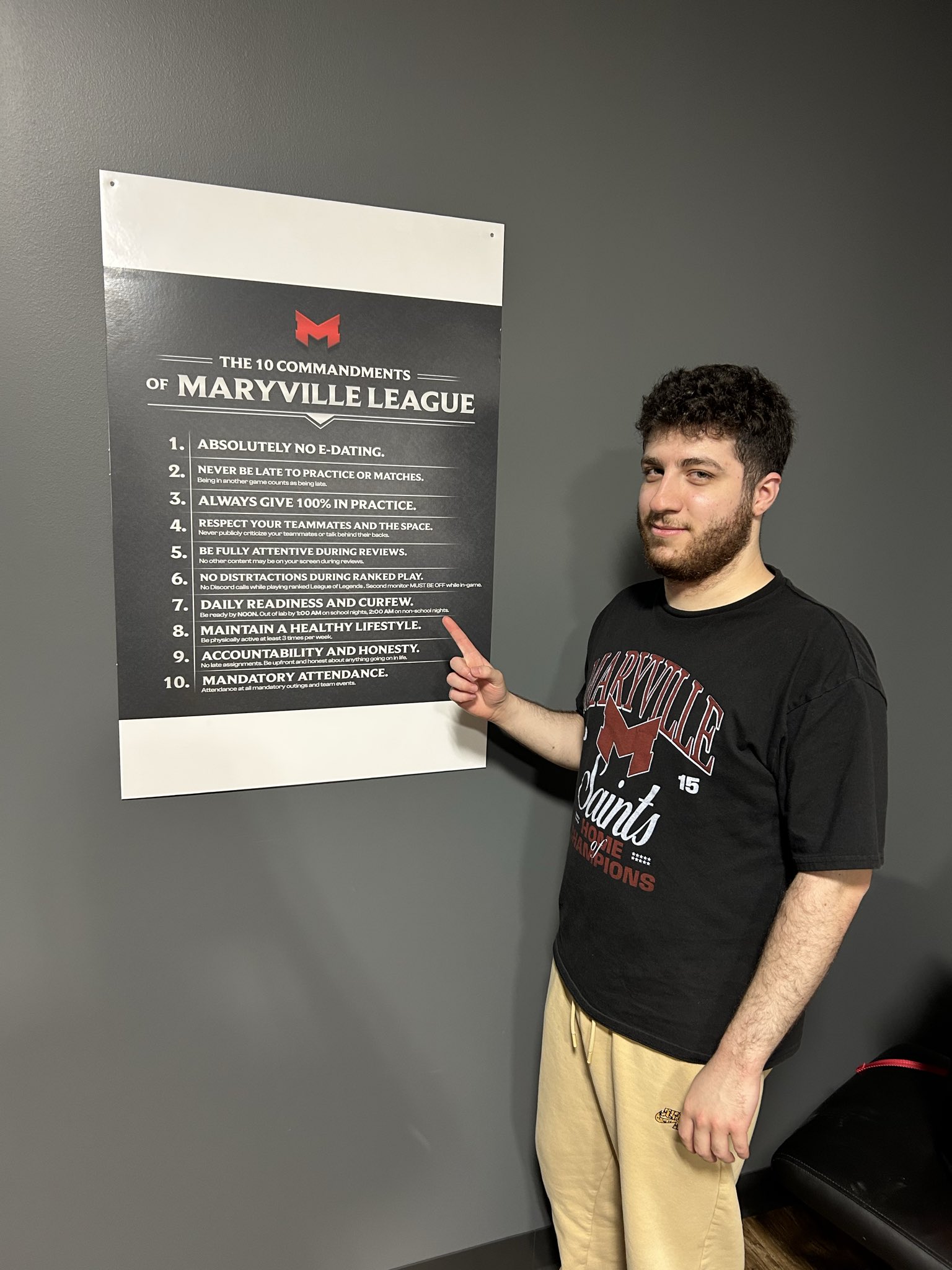

Here is my take on what they tried to do, using positive language:
1 - We build real relationships
We date in real life and keep our focus on the team, growth, and our future.
2 - We will always be on time for practice or matches
- We are physically and mentally 100% available when practice starts
3 - We always give 100% in practice
- Every drill, every scrim, every review. Effort is non-negotiable.
4 - We respect our teammates and the space
- We support each other in public and only talk about each other when we are together.
5 - We are fully attentive during reviews
- When we review, we focus. One screen. One goal. Learning
6 - We are 100% locked-in and focused during ranked play
- We only have one monitor on and remove distractions.
7 - We have daily readiness and respect curfew
- We are ready by NOON, out of the lab by 1:00 AM on school nights, 2:00 AM on non-school nights.
8 - We maintain a healthy lifestyle
- We are physically active at least 3 times per week
9 - We are accountable and honest
- We turn our assignments in on time. We are upfront and honest about anything going on in life.
10 - We show up for the team
- We attend mandatory events and team activities
One version reads like a list of things that already went wrong. The other reads like a group of people who decided who they want to be. That shift, from policing behavior to declaring identity, is the whole game. And the wild part is it costs nothing. Same rules. Different words. Completely different culture walking in the door every day.
Do you FEEL the difference in the environment immediately when you read it? I bet you do.
Look at Your Rules. Really Look at Them.
Pull up whatever document your team lives by right now. Read it again, but this time pay attention to the language.
How many rules start with "No"?
How many tell players what they cannot do, should not do, or are not allowed to do?
If the answer is most of them, you have a document that is quietly training your players to think in terms of restriction, avoidance, and punishment. Every time they read it, every time you reference it in a meeting, you are reinforcing a mindset built around fear of failure rather than pursuit of excellence.
And then you wonder why the energy in practice feels off. Why accountability conversations get defensive. Why your culture feels like it's always fighting against something instead of building toward something.
Your rules are doing that. Your words built that.
"We Don't" vs. "We Do"
The fix is not complicated, but it does require you to slow down and actually think about what you want.
Most rule-writing comes from a place of frustration. Something bad happened. A player showed up late. Someone was on their phone during film review. There was drama. So you write a rule about the thing that went wrong.
That's actually fine as a starting point. Write down everything you don't want. Get it all out.
But then you have to do the harder work. You have to stop and ask: what do I actually want instead?
Not "no phones during review." What DO you want? Full attention. One screen. One goal. Learning.
That's the rule. Write that one.
Not "don't be late." What do you want? Players who are physically and mentally 100% present when practice starts.
That's the standard. Put that on the wall.
The behavior you're asking for is the same. But the mental picture you're creating is completely different. One focuses your players on presence and readiness. The other focuses them on clocks and consequences.
The "We" Thing Matters More Than You Think
There's one more layer here that's easy to miss.
Look at how your rules are written. Are they "No player shall..." or "Players must not..." or some other version of talking AT your team?
Now look at what happens when you shift to "We."
We are fully attentive during reviews. We show up for each other. We give everything in every session.
Something shifts. It stops being a list of laws handed down from above. It becomes a shared identity. A statement of who this group is, not a list of behaviors being policed.
That's not just a nice sentiment. It's a genuine psychological shift in how players relate to the standard. The rule stops being something imposed on them and starts being something they belong to. Something they can hold each other to without it feeling like a power play.
Accountability in a "we" culture hits different. Because when someone falls short, it's not "you broke my rule." It's "that's not who we are." That's a much harder thing to shrug off.
This Is Uncomfortable If You're Honest About It
Here's where I need you to sit with something for a second.
If your culture has been struggling, if accountability keeps falling flat, if players seem checked out or resistant, it's worth asking: what have my words been building?
Not as a guilt trip. As a genuine diagnostic.
Because culture is not the poster on the wall. Culture is the sum of every message your players receive about what matters, what's expected, and who they are to each other. And a huge part of that message gets transmitted through the language you use every single day.
Negative language, at scale, over time, builds a negative environment. Not because anyone meant it to. But because that's what it does.
The good news is, it works the other way too. Positive, identity-based, forward-facing language builds environments where people want to show up, want to perform, and actually hold each other to something real.
You can build that. With words. Starting today.
The Rewrite Challenge
Take your current team agreements, rules or commandments. Every rule written as a "don't" or a "no" or a "players will not," flip it.
Ask yourself with every line: what do I want them to do?
Write that, and use the "we-language".
Then read the new version out loud to yourself and notice how it feels. Notice what it points you toward. Notice whether it sounds like a group of people who believe in something, or a group of people scared of getting in trouble.
That feeling is the difference between a team that grinds through a season and a team that actually builds something.
Small thing. Huge impact.
The best coaches already know this. Now you do too.
If you find this interesting and are looking to improve your coaching to the next level, and become a very competent coach with the right structures, environment-building skills, and transformative coaching skills, then the Esports Coach Revolution is the thing for you where will we will cover this in detail, and give you the tools to succeed.
Want to give your esports coaching a boost?
I can help you do it. Grab your FREE e-book about:
'The foundation of performance: How To Motivate Your Players'

